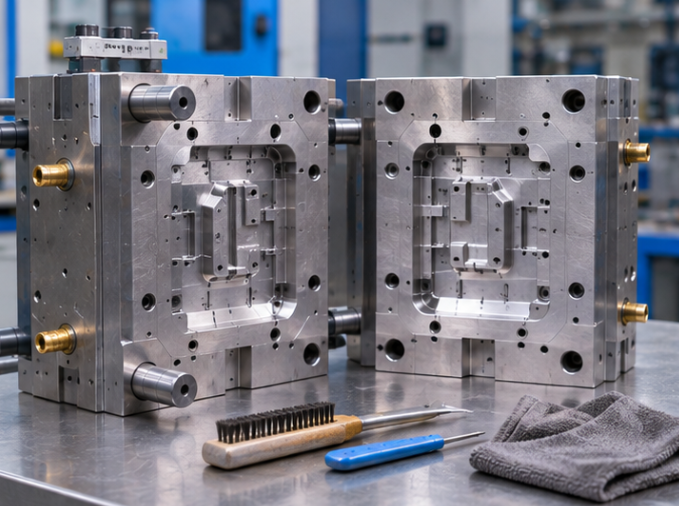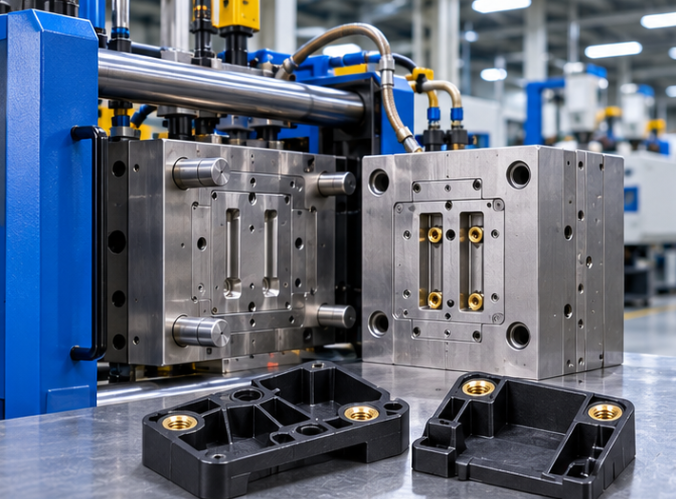

Choosing between a single cavity vs multi cavity mold affects more than the number of plastic parts a manufacturer produces in each injection molding cycle. It also influences tooling investment, production capacity, unit cost, maintenance, and long-term supply planning.
A single-cavity injection mold produces one part per cycle. A multi-cavity mold produces several identical parts in one cycle, which can increase output and reduce unit production costs when demand supports the additional tooling investment.
However, more cavities do not automatically deliver better economics. A larger mold may require more complex runners, cooling channels, machining, and process control. The molding cycle may also change as cavity count increases.
For OEM buyers and product engineers, the right choice depends on annual demand, peak delivery requirements, part geometry, cycle time, available equipment, and total manufacturing cost.
This guide compares both mold types, explains how to estimate production output, and shows how to evaluate the financial break-even point before selecting a tooling solution.
What Is a Single-Cavity Injection Mold?
A single-cavity injection mold contains one molding cavity and produces one finished part during each successful molding cycle.
The mold typically uses a relatively straightforward cavity arrangement. Engineers can focus on filling, cooling, ejection, and dimensional control for one molded component.
Compared with a multi-cavity design for the same part, a single-cavity mold often requires a lower initial tooling investment. It may also offer easier access for inspection, maintenance, and engineering adjustments.
Single-cavity molds can suit projects with limited annual demand, large or complex components, uncertain production forecasts, or significant development risk.
They can also support long-term production when the available capacity meets customer requirements.
A single-cavity mold is not necessarily a prototype mold. Manufacturers can use it for production programs that require consistent quality but do not justify additional cavities.
The main limitation is output. Since each cycle produces only one part, a single-cavity tool may need more machine hours to fulfill a large order.
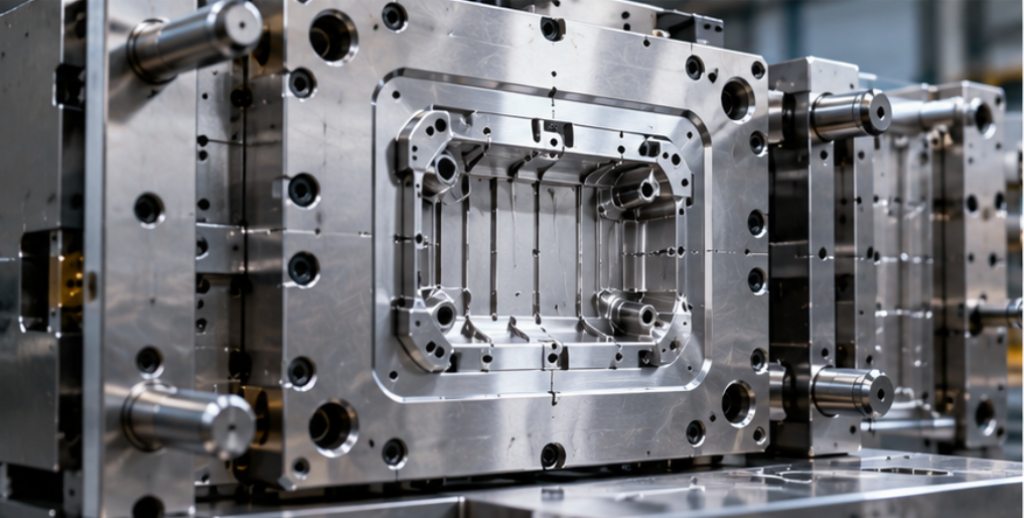
What Is a Multi-Cavity Injection Mold?
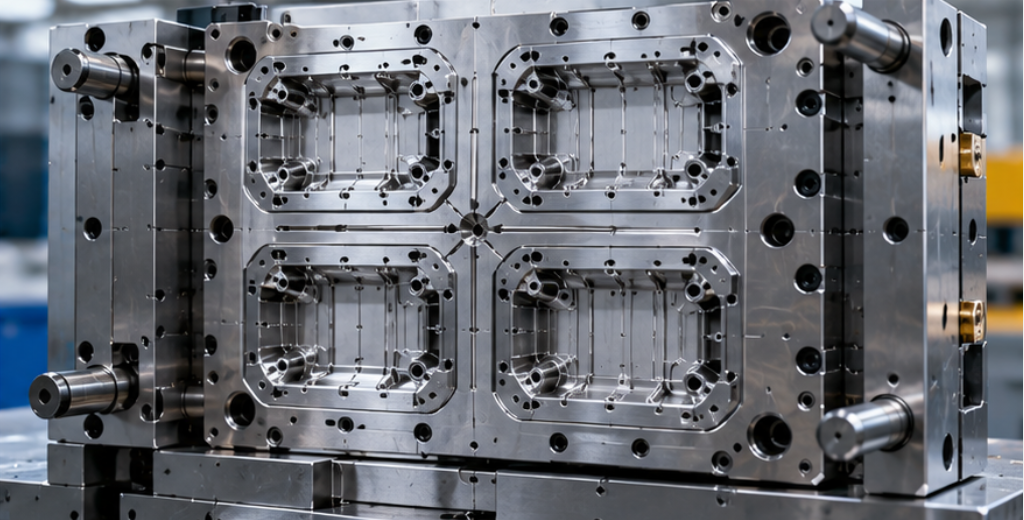
A multi-cavity injection mold contains two or more cavities that produce identical parts during the same molding cycle.
For example, a four-cavity mold can produce four parts per successful cycle, while an eight-cavity mold can produce eight.
Manufacturers may consider two, four, eight, or other cavity counts depending on the part dimensions, required output, mold size, and machine capability.
Multi-cavity tooling can increase production output without requiring a separate molding cycle for every part.
However, engineers must consider how the molding system distributes material across the cavities. They also need to evaluate cooling consistency, injection pressure, ejection, runner design, and dimensional variation between cavities.
Increasing cavity count can also increase the required shot size, mold dimensions, and clamping force.
Importantly, a multi-cavity mold normally produces multiple copies of the same part. A family mold, by contrast, produces different parts within one mold. These arrangements involve different filling and production considerations.
Multi-cavity tooling often makes sense for stable production programs where higher output can justify the additional engineering and manufacturing investment.
Single-Cavity vs Multi-Cavity Mold: Key Differences
The main difference between single-cavity and multi-cavity injection molds is the number of parts each tool can produce per cycle. That difference influences the entire manufacturing plan.
| Comparison Factor | Single-Cavity Mold | Multi-Cavity Mold |
|---|---|---|
| Parts per cycle | One | Two or more |
| Initial tooling cost | Usually lower for the same part | Usually higher due to additional cavities and mold complexity |
| Tooling structure | Generally simpler | Requires additional cavity layouts and balanced systems |
| Production output | Lower output per cycle | Higher potential output per cycle |
| Unit production cost | May remain higher at large volumes | May decrease when production volume supports the investment |
| Process control | Focuses on one cavity | Must maintain consistency across multiple cavities |
| Maintenance | Often simpler to inspect and service | May involve more components and cavity-specific maintenance |
| Typical application | Lower demand, complex parts, or limited capacity requirements | Stable demand and higher production requirements |
These comparisons describe common manufacturing conditions rather than fixed rules.
A complex single-cavity mold may cost more than a simple multi-cavity mold for a different product. Likewise, an efficiently designed multi-cavity tool can deliver excellent dimensional consistency when the manufacturer controls filling, cooling, and processing conditions.
Buyers should compare tooling proposals for the same part, material, quality requirements, and production forecast.
How Does Cavity Count Affect Production Output?
Cavity count directly affects the number of parts a mold can produce in each successful cycle. However, cycle time also determines how many cycles the machine can complete in an hour.
Calculate Theoretical Parts per Hour
Use the following formula to estimate theoretical output:
Theoretical Parts per Hour = (3,600 ÷ Cycle Time in Seconds) × Number of Cavities
For example, a single-cavity mold with a 30-second cycle produces a theoretical 120 parts per hour.
A four-cavity mold with a 35-second cycle produces approximately 411 parts per hour.
The following table compares several illustrative scenarios.
| Cavity Count | Assumed Cycle Time | Theoretical Output per Hour |
|---|---|---|
| 1 cavity | 30 seconds | 120 parts |
| 2 cavities | 32 seconds | 225 parts |
| 4 cavities | 35 seconds | Approximately 411 parts |
| 8 cavities | 40 seconds | 720 parts |
These figures are hypothetical examples for calculation purposes. They do not represent verified PALUM equipment performance or production capacity.
Notice that cycle time increases in this example as cavity count increases. Actual cycle time does not necessarily follow this pattern. Cooling requirements, part geometry, runner design, machine capability, and process settings determine the result.
Calculate Good-Part Output
Real production includes downtime, setup interruptions, and rejected parts.
For a simplified estimate, buyers can apply equipment availability and good-part yield to the theoretical output.
Good Parts per Hour = Theoretical Parts per Hour × Availability × Good-Part Yield
Suppose the four-cavity example achieves 90% equipment availability and a 98% good-part yield.
The estimated output becomes:
411.4 × 0.90 × 0.98 ≈ 363 good parts per scheduled hour.
This simplified model assumes that availability represents the proportion of scheduled time spent running at the stated cycle time, while good-part yield represents the proportion of produced parts that pass inspection.
It does not account separately for additional speed losses. Avoid applying the same losses twice when using plant efficiency data.
Convert Hourly Output Into Production Capacity
Buyers should also calculate the available production hours.
For example, a program that requires 100,000 good parts annually will need approximately 276 scheduled machine hours at an estimated output of 363 good parts per hour.
That estimate does not include extra scheduling allowances for tooling changes, maintenance, material availability, or production uncertainty beyond the assumptions already included.
Manufacturers should confirm whether the machine has enough available capacity to meet both annual demand and peak delivery requirements.
How Do Single-Cavity and Multi-Cavity Mold Costs Compare?
When buyers compare mold options, they should separate the initial tooling investment from the ongoing cost of producing each acceptable part.
Initial Tooling Investment
A single-cavity mold usually requires fewer cavity components and a simpler overall layout for the same part.
A multi-cavity mold may require additional cavity machining, more complex runners, larger mold plates, expanded cooling circuits, and additional ejection components.
These features can increase engineering work, machining time, and initial tooling cost.
However, the relationship is not always proportional. A four-cavity mold does not necessarily cost four times as much as a single-cavity mold.
Tool design, cavity arrangement, part complexity, mold material, and manufacturing requirements determine the actual quotation.
For more detail on the factors that influence tooling quotations, review our injection mold cost guide.
Production Cost per Part
Unit production cost depends on more than the number of cavities.
Manufacturers must consider machine hourly rates, molding cycle time, material consumption, runner waste, labor, automation, scrap, and quality inspection.
When a multi-cavity mold produces more acceptable parts per machine hour, it can distribute machine operating costs across a larger number of parts.
However, a larger tool may also require a more expensive machine, longer setup time, or additional maintenance.
Buyers should compare the cost per acceptable finished part rather than simply dividing machine cost by the nominal cavity count.
Total Project Cost
A simplified project-cost model is:
Total Project Cost = Initial Tooling Cost + (Unit Production Cost × Total Good Parts Required)
This formula provides a starting point for comparing two tooling options under consistent assumptions.
A complete financial comparison may also include maintenance, financing, inventory, tooling modifications, production interruptions, and other project-specific costs.
For long-running production programs, relatively small unit-cost differences can become significant as cumulative volume increases.
When Does a Multi-Cavity Mold Become Cost-Effective?
A multi-cavity mold becomes financially attractive when the expected production savings justify its additional tooling investment.
Buyers can estimate the break-even volume with the following formula:
Break-Even Volume = Additional Tooling Investment ÷ Unit Production Cost Savings
Example: Single-Cavity vs Four-Cavity Tooling
Consider a hypothetical plastic component with two possible tooling arrangements.
| Cost Item | Single-Cavity Mold | Four-Cavity Mold |
|---|---|---|
| Initial tooling cost | $8,000 | $20,000 |
| Production cost per good part | $0.65 | $0.45 |
| Additional tooling investment | — | $12,000 |
| Unit production savings | — | $0.20 |
The four-cavity mold requires an additional $12,000 in tooling investment but saves an assumed $0.20 per acceptable part.
Break-Even Volume = $12,000 ÷ $0.20 = 60,000 parts
At 60,000 acceptable parts, both options reach the same simplified total cost:
- Single-cavity: $8,000 + (60,000 × $0.65) = $47,000
- Four-cavity: $20,000 + (60,000 × $0.45) = $47,000
At 100,000 acceptable parts, the comparison changes:
- Single-cavity: $8,000 + (100,000 × $0.65) = $73,000
- Four-cavity: $20,000 + (100,000 × $0.45) = $65,000
Under these assumptions, the four-cavity option saves $8,000 over the 100,000-part production program.
All figures are illustrative, not PALUM quotations. The model assumes comparable accepted-part quality and excludes differences in financing, maintenance, scheduling, and other costs not included in the stated unit rates.
In practice, a buyer should also consider how quickly the project will reach the break-even quantity.
A product that requires 60,000 parts over several years creates a different investment situation from one that needs the same quantity within a few months.
Production demand, delivery deadlines, and available capacity may justify a higher-cavity mold even when the simplified financial break-even point remains some distance away.
How Does Cavity Count Affect Part Quality and Mold Design?
Multi-cavity molds introduce additional engineering requirements because every cavity must produce parts that meet the same specifications.
Runner and Filling Balance
Engineers must design the runner and gating system to distribute material appropriately across the cavities.
Differences in flow resistance, pressure, or temperature can affect filling behavior and part consistency.
Balanced runner layouts and suitable process settings help reduce these variations.
Cooling Consistency
Cooling strongly influences molding cycle time and dimensional stability.
A multi-cavity tool needs an effective cooling strategy for all cavities. Uneven cooling may contribute to dimensional variation, distortion, or inconsistent cycle performance.
Engineers should review cooling-channel placement, part geometry, mold construction, and thermal conditions during tool design.
Cavity-to-Cavity Dimensional Variation
Even when a mold produces identical components, individual cavities may show small dimensional differences.
Manufacturers can evaluate these differences through cavity identification, measurement, process monitoring, and appropriate inspection plans.
For components with critical assembly dimensions, buyers should agree on acceptance requirements and the inspection approach before tooling approval.
Machine Capacity and Mold Size
Additional cavities increase the total volume of material that the machine must inject during each cycle.
Engineers must confirm the available shot capacity, injection capability, clamping force, mold dimensions, and machine compatibility.
Part size and projected area can limit practical cavity count even when production demand is high.
Maintenance and Production Risk
More cavities can mean more mold components to inspect and maintain.
A problem in one cavity may affect the production plan, although some tooling designs allow operators to isolate an affected cavity under controlled conditions.
Maintenance planning, spare components, and cavity-level quality records can help manage these risks.
Neither mold type guarantees better part quality. Engineering design and process control determine whether the selected tool can meet production requirements.
A structured DFM for injection molding review can help identify geometry, filling, cooling, and tooling risks before mold manufacturing begins.
How to Choose the Right Number of Mold Cavities
The most practical approach is to select cavity count around the project’s production requirements rather than starting with the largest available mold.
1. Confirm Annual and Peak Demand
Start with the expected annual quantity, monthly delivery schedule, and maximum short-term demand.
A stable program with substantial annual volume may justify a multi-cavity investment. A product with uncertain demand may benefit from a smaller initial tooling commitment.
2. Estimate Cycle Time and Required Capacity
Use realistic cycle-time assumptions to calculate the output of each proposed cavity arrangement.
Include expected availability, good-part yield, and scheduled production hours.
Compare the results with the customer’s delivery requirements.
3. Review Part Geometry and Machine Limits
Check whether the part dimensions, mold construction, cooling requirements, and machine capability support the proposed cavity count.
Large parts, demanding tolerances, or complex mold mechanisms may limit the number of practical cavities.
4. Compare Tooling and Unit Production Costs
Request quotations that separate initial tooling investment from estimated production cost per acceptable part.
Calculate the financial break-even volume and compare it with the expected lifetime demand.
5. Evaluate Quality and Maintenance Requirements
Consider cavity balancing, inspection methods, maintenance access, spare parts, and the consequences of production interruptions.
For high-precision components, stable production may matter more than maximizing theoretical output.
6. Confirm the Tooling and Launch Schedule
More complex tooling can require additional engineering, machining, assembly, and validation work.
However, cavity count alone does not determine manufacturing lead time.
Buyers should review the complete schedule, including mold design approval, tooling manufacture, trials, and sample evaluation.
Our injection mold lead time guide explains how these stages affect project planning.
Once the engineering and commercial requirements are clear, buyers can compare suitable options for custom injection mold manufacturing.
Frequently Asked Questions About Single-Cavity and Multi-Cavity Molds
What is the difference between single-cavity and multi-cavity molds?
A single-cavity mold produces one plastic part per successful injection molding cycle. A multi-cavity mold produces two or more identical parts during the same cycle. Multi-cavity tooling can increase output, but it usually requires a higher initial investment and more detailed control of filling, cooling, and cavity-to-cavity consistency.
Is a multi-cavity mold always more expensive?
For the same part and comparable specifications, a multi-cavity mold generally requires a higher initial tooling investment because it contains additional cavities and associated mold systems. However, it may reduce the production cost per acceptable part at sufficient volume. Buyers should compare total project costs rather than judging the options by tooling price alone.
How many parts can a four-cavity mold produce per hour?
Output depends on cycle time. For example, a four-cavity mold with a 30-second cycle can theoretically produce 480 parts per hour. Actual good-part output will be lower if downtime, rejected parts, or slower operating conditions reduce production. Manufacturers should calculate capacity using realistic cycle-time and efficiency assumptions.
When should I choose a multi-cavity injection mold?
Consider a multi-cavity mold when production demand is stable, annual quantities are substantial, and higher output can justify the additional tooling investment. The part geometry, molding machine capability, required quality, and delivery schedule must also support the design. A cost and capacity comparison can help determine the appropriate number of cavities.
Does a multi-cavity mold affect part quality?
A multi-cavity mold can produce consistent, high-quality parts when engineers properly design the runner system, cooling, gating, and cavity geometry. However, manufacturers must monitor potential differences between cavities. Quality depends on mold design, material behavior, processing conditions, and inspection rather than cavity count alone.
Final Thoughts: Match Cavity Count to Production Demand
The decision between a single cavity vs multi cavity mold should reflect the complete production program.
Single-cavity tooling often offers a lower initial investment and a straightforward manufacturing arrangement. Multi-cavity tooling can increase output and reduce unit costs when production demand supports the additional investment.
Neither option is automatically the best choice. Annual volume, cycle time, tooling complexity, machine capacity, quality requirements, and lifetime project cost should guide the decision.
If you are planning a new injection-molded component, share your CAD drawings, material requirements, estimated annual volume, and delivery targets with PALUM through our project inquiry page. These details provide a practical starting point for evaluating suitable mold cavity arrangements and manufacturing requirements.